Origins of modern agriculture (part of an introductory course intended for 2nd year undergraduates)
Prof. Jim Haseloff, University of Cambridge
This short series of lectures will provide an overview of the history of plant domestication, the advent of new technologies for crop improvement, and a view of current trends for the engineering of new traits. The lectures also provide background for the associated practical sessions, with an introduction to plant transformation, design of synthetic plant genes and use of reporter genes.
Lecture 1. Plant breeding and transformation
(i) Crop domestication, with maize as an example
(ii) Modern agriculture, hybrid maize and the rise of agribusiness
(iii) Green Revolution
(iv) Agrobacterium mediated plant transformation
Click here to see an online presentation of the supporting images
Click here to download a PDF version of the images
Lecture 2. From genotype to phenotype
(i) Designing synthetic plant genes
(ii) Single gene traits: pest and herbicide resistance
(iii) Reporter genes
(iv) Microscopy
Click here to see an online presentation of the supporting images
Click here to download a PDF version of the images
Lecture 3. New tools for engineering future crop traits
(i) Complex traits and breeding
(ii) Reprogramming regulatory networks
Engineering new metabolic pathways
Loss-of-function e.g. for reduced pod shatter
Re-wiring networks e.g. modification of tomato plants
Selective amplification of pathways e.g. expansion of structural tissues
Click here to see an online presentation of the supporting images
Click here to download a PDF version of the images
Lecture 1. Plant breeding and transformation
(i) Crop domestication, with maize as an example
(ii) Modern agriculture, hybrid maize and the rise of agribusiness
(iii) Green Revolution
(iv) Agrobacterium mediated plant transformation
Click here to see an online presentation of the supporting images
Click here to download a PDF version of the images
Lecture 2. From genotype to phenotype
(i) Designing synthetic plant genes
(ii) Single gene traits: pest and herbicide resistance
(iii) Reporter genes
(iv) Microscopy
Click here to see an online presentation of the supporting images
Click here to download a PDF version of the images
Lecture 3. New tools for engineering future crop traits
(i) Complex traits and breeding
(ii) Reprogramming regulatory networks
Engineering new metabolic pathways
Loss-of-function e.g. for reduced pod shatter
Re-wiring networks e.g. modification of tomato plants
Selective amplification of pathways e.g. expansion of structural tissues
Click here to see an online presentation of the supporting images
Click here to download a PDF version of the images
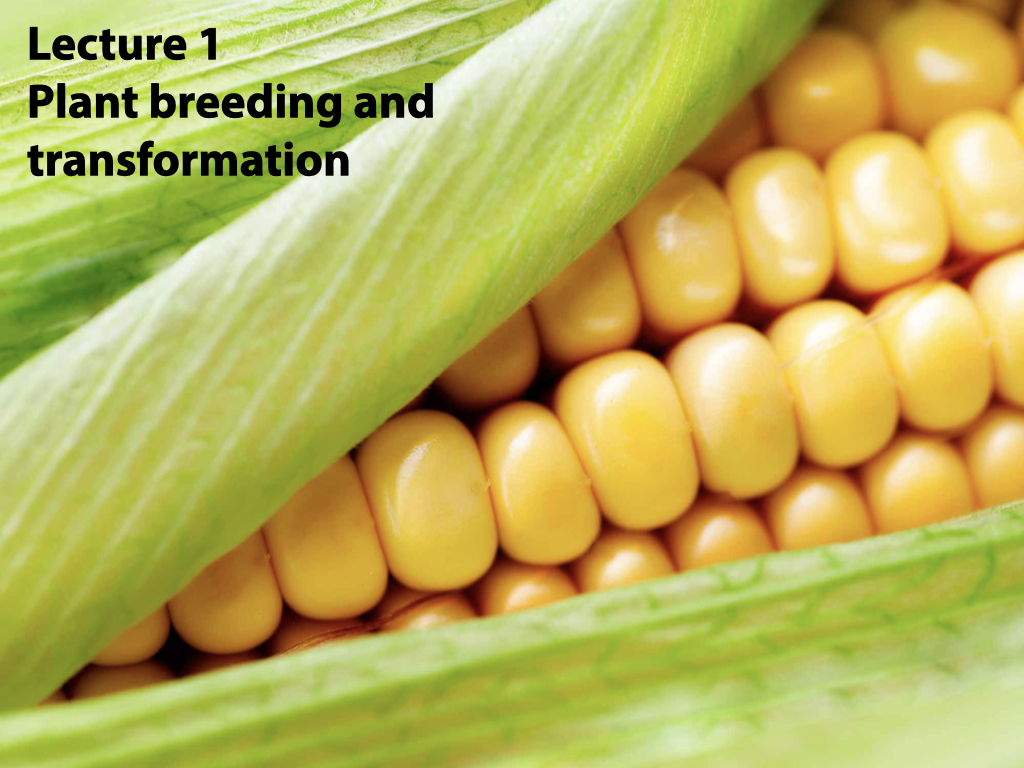
Lecture 1 outline: Plant breeding and transformation
Geographical Centers of Crop Diversity
Nicolai Vavilov, a Russian biologist, popularised the concept of geographical centres of diversity for modern crop species. These centres correspond to areas of botanical diversity and coincide with the early human societies and plant domestication.
Human Migration and the Domestication of Crops
Anatomically modern humans originated in East Africa and migrated into Europe, Asia, and the Americas over 65,000 years ago. By 15,000 years ago, they had reached Mesoamerica and transitioned from a nomadic lifestyle to agriculture, beginning the domestication of local plants such as maize.
Archaeological Evidence for Maize Domestication: The evolution of maize is depicted through dioramas and based on archaeological findings and historical records. Evidence from the Tehuacan Valley indicates maize was domesticated around 7,000 years ago, and plant remains show a progression from small, vestigial forms to modern ones due to selective breeding.
Teosinte as the Progenitor: Early maize strongly resembled teosinte, a Mesoamerican subspecies of Zea mays. The transition from teosinte to maize involved selecting for larger cobs and kernel architecture, resulting in modern maize forms. The habits of teosinte, such as its branched structure and protective seed coverings, contrast with modern maize's tall, apically dominant growth.
Genetic Variation and Selection
Primitive maize and teosinte were self-fertilising and true-breeding plants with natural genetic variation. Early agriculturalists selected plants with desirable traits, leading to a variety of maize forms adapted for different uses and environments. This resulted in a rich diversity of maize varieties, many of which have been preserved and conserved by seed banks like those of the International Maize and Wheat Improvement Center (CIMMYT).
Spread and Significance of Maize
Maize became a staple crop across Mesoamerica, taking on cultural and religious significance. It spread widely across North and South America, resulting in diverse true-breeding populations.
Modern Analysis of Maize Domestication
Genetic studies, such as those conducted by John Doebley's lab, have identified genes responsible for key differences between teosinte and maize, including those affecting branching, morphology, and floral structure. Approximately 90% of the differences between the two plants are due to a handful of genetic loci.
The Adoption of Maize in the United States
Native Americans had long grown maize varieties. Europeans also adopted maize as a crop in the U.S., and by the 1800s, it was widely planted in the Midwest. Farmers were self-sufficient, relying on traditional methods and minimal external inputs for maize cultivation.
Introduction of Hybrid Maize
In the 1900s, scientists like G.H. Shull observed that inbreeding reduced productivity. Hybridisation (cross-breeding) increased yields, leading to the establishment of plant breeding stations and the commercialisation of hybrid maize seed by entrepreneurs like Roswell Garst and Henry Wallace. The adoption of hybrid maize transformed farming from a traditional occupation to an industrialised agribusiness, reducing maize diversity and increasing reliance on synthetic inputs.
Global Impact of Maize Production
Today, maize production exceeds 1 gigaton annually, surpassing wheat and rice. The U.S. and China are the leading producers. Selective breeding has also improved other crops like wheat, with efforts led by Norman Borlaug during the Green Revolution, significantly increasing grain yields worldwide.
Advancements in Genetic Modification
Until the 1980s, crop improvement relied on sexual crossing and breeding. The development of transgenic techniques, beginning in 1983, enabled precise genetic modifications. Agrobacterium tumefaciens, a bacterial pathogen, was harnessed to transfer engineered genes into plants, marking the beginning of a new era in genetic crop improvement.
Mechanism of Agrobacterium-Mediated Transformation
Agrobacterium tumefaciens binds to plant cells, transferring a segment of DNA (T-DNA) via its Type IV secretion system, resulting in plant cell transformation. This system can be modified to create transgenic plants without the tumorigenic effects, allowing the introduction of new genes through a binary plasmid system. The process includes co-cultivation with engineered bacteria, selection, and regeneration of transgenic plants.
Alternative Methods of Genetic Transformation
Besides Agrobacterium, the biolistic method (high-velocity DNA-coated particles) is used for transforming plants and organelles like chloroplasts. It allows targeted delivery and expression of genes, demonstrated through techniques like fluorescent protein tagging.
Future Directions and Applications
The advancements in transgenic technology allow for detailed exploration of gene structure, the development of commercial crops, and the use of reporter genes to study genotype-phenotype links. The lecture series aims to explore these applications and recent milestones in transgenic plant development further.
Nicolai Vavilov, a Russian biologist, popularised the concept of geographical centres of diversity for modern crop species. These centres correspond to areas of botanical diversity and coincide with the early human societies and plant domestication.
Human Migration and the Domestication of Crops
Anatomically modern humans originated in East Africa and migrated into Europe, Asia, and the Americas over 65,000 years ago. By 15,000 years ago, they had reached Mesoamerica and transitioned from a nomadic lifestyle to agriculture, beginning the domestication of local plants such as maize.
Archaeological Evidence for Maize Domestication: The evolution of maize is depicted through dioramas and based on archaeological findings and historical records. Evidence from the Tehuacan Valley indicates maize was domesticated around 7,000 years ago, and plant remains show a progression from small, vestigial forms to modern ones due to selective breeding.
Teosinte as the Progenitor: Early maize strongly resembled teosinte, a Mesoamerican subspecies of Zea mays. The transition from teosinte to maize involved selecting for larger cobs and kernel architecture, resulting in modern maize forms. The habits of teosinte, such as its branched structure and protective seed coverings, contrast with modern maize's tall, apically dominant growth.
Genetic Variation and Selection
Primitive maize and teosinte were self-fertilising and true-breeding plants with natural genetic variation. Early agriculturalists selected plants with desirable traits, leading to a variety of maize forms adapted for different uses and environments. This resulted in a rich diversity of maize varieties, many of which have been preserved and conserved by seed banks like those of the International Maize and Wheat Improvement Center (CIMMYT).
Spread and Significance of Maize
Maize became a staple crop across Mesoamerica, taking on cultural and religious significance. It spread widely across North and South America, resulting in diverse true-breeding populations.
Modern Analysis of Maize Domestication
Genetic studies, such as those conducted by John Doebley's lab, have identified genes responsible for key differences between teosinte and maize, including those affecting branching, morphology, and floral structure. Approximately 90% of the differences between the two plants are due to a handful of genetic loci.
The Adoption of Maize in the United States
Native Americans had long grown maize varieties. Europeans also adopted maize as a crop in the U.S., and by the 1800s, it was widely planted in the Midwest. Farmers were self-sufficient, relying on traditional methods and minimal external inputs for maize cultivation.
Introduction of Hybrid Maize
In the 1900s, scientists like G.H. Shull observed that inbreeding reduced productivity. Hybridisation (cross-breeding) increased yields, leading to the establishment of plant breeding stations and the commercialisation of hybrid maize seed by entrepreneurs like Roswell Garst and Henry Wallace. The adoption of hybrid maize transformed farming from a traditional occupation to an industrialised agribusiness, reducing maize diversity and increasing reliance on synthetic inputs.
Global Impact of Maize Production
Today, maize production exceeds 1 gigaton annually, surpassing wheat and rice. The U.S. and China are the leading producers. Selective breeding has also improved other crops like wheat, with efforts led by Norman Borlaug during the Green Revolution, significantly increasing grain yields worldwide.
Advancements in Genetic Modification
Until the 1980s, crop improvement relied on sexual crossing and breeding. The development of transgenic techniques, beginning in 1983, enabled precise genetic modifications. Agrobacterium tumefaciens, a bacterial pathogen, was harnessed to transfer engineered genes into plants, marking the beginning of a new era in genetic crop improvement.
Mechanism of Agrobacterium-Mediated Transformation
Agrobacterium tumefaciens binds to plant cells, transferring a segment of DNA (T-DNA) via its Type IV secretion system, resulting in plant cell transformation. This system can be modified to create transgenic plants without the tumorigenic effects, allowing the introduction of new genes through a binary plasmid system. The process includes co-cultivation with engineered bacteria, selection, and regeneration of transgenic plants.
Alternative Methods of Genetic Transformation
Besides Agrobacterium, the biolistic method (high-velocity DNA-coated particles) is used for transforming plants and organelles like chloroplasts. It allows targeted delivery and expression of genes, demonstrated through techniques like fluorescent protein tagging.
Future Directions and Applications
The advancements in transgenic technology allow for detailed exploration of gene structure, the development of commercial crops, and the use of reporter genes to study genotype-phenotype links. The lecture series aims to explore these applications and recent milestones in transgenic plant development further.
Extended reading:
Adaptation and the Geographic Spread of Crop Species. RM Gutaker and MD Purugganan, Annual Review of Plant Biology 75:679-706, 2024.
Recent advances in crop transformation technologies. Z Chen, JM. Debernardi, J Dubcovsky & Andrea Gallavotti Nature Plants 8:1343-1351, 2022.
Biotechnology in the 1930s: the development of hybrid maize. DN Duvick, Nature Reviews Genetics 2:69-73, 2001.
The scientific roots of modern plant biotechnology. IM Sussex, The Plant Cell 20:1189-1198, 2008.
Agrobacterium: nature's genetic engineer. EW Nester, Frontiers in Plant Science 5:1-16, 2015.
Popped Secret: The Mysterious Origin of Corn: video film from HHMI https://www.biointeractive.org/classroom-resources/popped-secret-mysterious-origin-corn Guide for the above film, with much useful information (Download "Educator materials" as PDF) https://www.biointeractive.org/classroom-resources/activity-popped-secret-mysterious-origin-corn
Adaptation and the Geographic Spread of Crop Species. RM Gutaker and MD Purugganan, Annual Review of Plant Biology 75:679-706, 2024.
Recent advances in crop transformation technologies. Z Chen, JM. Debernardi, J Dubcovsky & Andrea Gallavotti Nature Plants 8:1343-1351, 2022.
Biotechnology in the 1930s: the development of hybrid maize. DN Duvick, Nature Reviews Genetics 2:69-73, 2001.
The scientific roots of modern plant biotechnology. IM Sussex, The Plant Cell 20:1189-1198, 2008.
Agrobacterium: nature's genetic engineer. EW Nester, Frontiers in Plant Science 5:1-16, 2015.
Popped Secret: The Mysterious Origin of Corn: video film from HHMI https://www.biointeractive.org/classroom-resources/popped-secret-mysterious-origin-corn Guide for the above film, with much useful information (Download "Educator materials" as PDF) https://www.biointeractive.org/classroom-resources/activity-popped-secret-mysterious-origin-corn
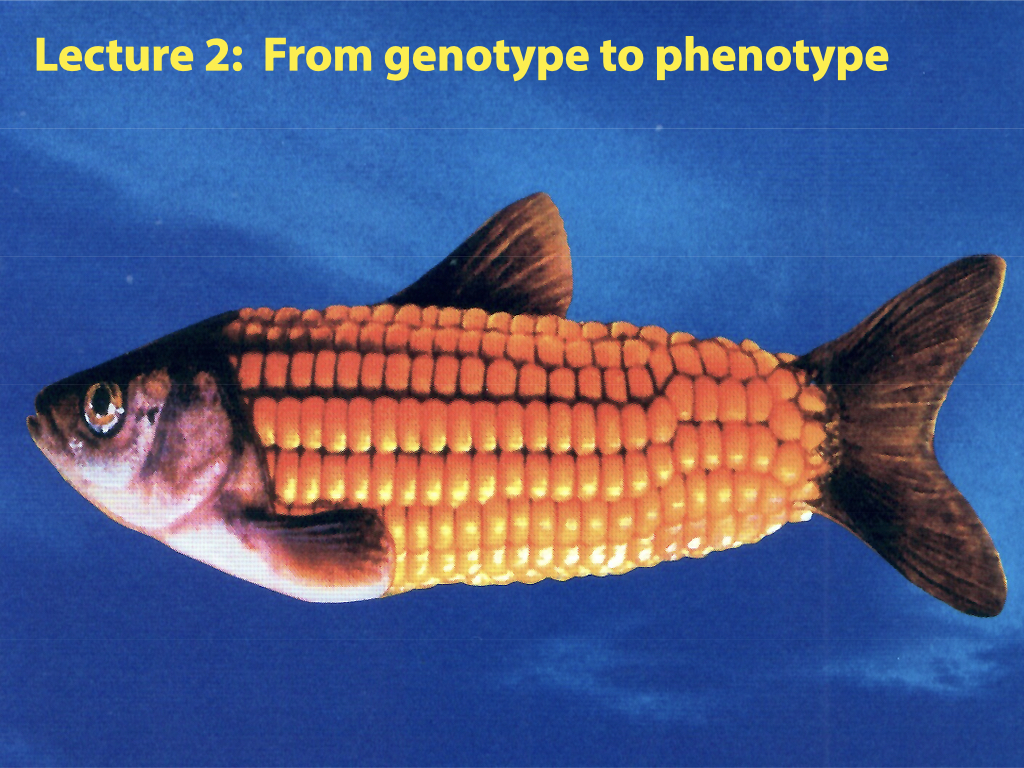
Lecture 2 routline: From genotype to phenotype
Agrobacterium-Mediated Plant Transformation
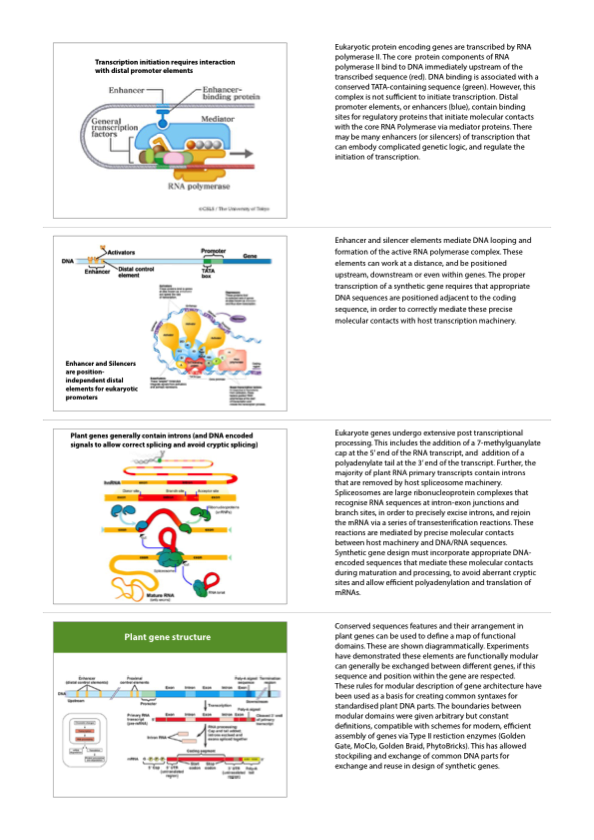
Binary plasmid vectors are derived from tumourigenic Ti plasmids for Agrobacterium-mediated transformation. These vectors contain a backbone with origins of replication, a bacterial selection marker, and T-DNA marked by 25 base-pair left and right border sequences for plant transfer. The T-DNA includes genes of interest and a selection marker for transformed plant rescue.
Gene Control and Expression in Plant Transformation
Foreign DNA must include control sequences compatible with plant transcription factors, RNA polymerase, and regulatory proteins to ensure proper expression. Chromatin structure around the insertion site can also influence gene activity.
Design of Synthetic Genes
Designing synthetic genes involves incorporating control sequences that enable regulated transcription and efficient translation. The synthetic gene's behavior must be analysed in situ after introduction into the plant.
Transcription Mechanisms in Eukaryotes
Eukaryotic protein-encoding genes are transcribed by RNA polymerase II, which binds upstream of the transcribed sequence at the TATA box. Enhancers or silencer elements regulate transcription initiation through interactions with RNA polymerase and mediator proteins.
Post-Transcriptional Processing of Plant Genes
Plant genes undergo post-transcriptional modifications, including 5’ capping, 3’ polyadenylation, and intron removal by spliceosomes. Proper synthetic gene design must ensure these processes are accurately mediated by host machinery.
Modular Architecture of Plant Genes
Conserved sequences in plant genes allow a modular design approach. The domains are functionally interchangeable if sequence and position are maintained, enabling the creation of standardised plant DNA parts for synthetic genes using modular cloning techniques.
Commercial Release of Genetically Modified Crops
Genetically modified crops were first released in the mid-1990s, introducing traits like insect, herbicide, and virus resistance.
Bt Toxin: Insect Resistance in GM Crops
Bacillus thuringiensis (Bt) produces a protein toxin effective against insects but safe for mammals. Bt toxins have been used in organic farming and transgenic plants to control pests. Bt toxin mechanisms involve binding to gut receptors in insects, leading to pore formation and cell leakage.
Glyphosate Resistance and No-Till Agriculture
Glyphosate, an herbicide, inhibits the shikimate pathway in plants. Transgenic crops expressing resistant enzymes allow no-till farming practices, reducing erosion. However, herbicide resistance in weeds has emerged, leading to the development of crops with multiple herbicide resistance traits.
Stacked Traits in Transgenic Crops
Modern GM crops contain stacked traits like herbicide resistance and Bt toxin expression, providing comprehensive pest and weed control solutions. These developments are due to synthetic genes integrated into crop genomes.
Reporter Genes in Synthetic Gene Studies
Reporter genes, such as those encoding β-glucuronidase (GUS), allow visualization of gene activity. The GUS gene produces a blue product upon reaction with the X-gluc substrate, revealing expression patterns but often killing the plant tissue in the process.
Green Fluorescent Protein (GFP) and Fluorescence Imaging
GFP, derived from the jellyfish Aequoria victoria, is used to visualise gene expression in living cells. GFP emits green light upon excitation and can be visualised using fluorescence microscopy. Variations in GFP-like proteins provide diverse colours for reporter studies.
Fluorescence Microscopy Techniques
Fluorescence microscopy detects emitted light from fluorescent proteins, allowing the visualisation of cellular features. Confocal microscopy provides high-resolution imaging by focusing laser light, creating optical sections that eliminate out-of-focus blur.
Applications of Confocal Microscopy in Plant Research
Confocal microscopy enables detailed examination of plant tissues, such as chloroplasts and GFP expression in Arabidopsis. It also tracks gene expression and movement of tagged viruses across plant cells.
Binary plasmid vectors are derived from tumourigenic Ti plasmids for Agrobacterium-mediated transformation. These vectors contain a backbone with origins of replication, a bacterial selection marker, and T-DNA marked by 25 base-pair left and right border sequences for plant transfer. The T-DNA includes genes of interest and a selection marker for transformed plant rescue.
Gene Control and Expression in Plant Transformation
Foreign DNA must include control sequences compatible with plant transcription factors, RNA polymerase, and regulatory proteins to ensure proper expression. Chromatin structure around the insertion site can also influence gene activity.
Design of Synthetic Genes
Designing synthetic genes involves incorporating control sequences that enable regulated transcription and efficient translation. The synthetic gene's behavior must be analysed in situ after introduction into the plant.
Transcription Mechanisms in Eukaryotes
Eukaryotic protein-encoding genes are transcribed by RNA polymerase II, which binds upstream of the transcribed sequence at the TATA box. Enhancers or silencer elements regulate transcription initiation through interactions with RNA polymerase and mediator proteins.
Post-Transcriptional Processing of Plant Genes
Plant genes undergo post-transcriptional modifications, including 5’ capping, 3’ polyadenylation, and intron removal by spliceosomes. Proper synthetic gene design must ensure these processes are accurately mediated by host machinery.
Modular Architecture of Plant Genes
Conserved sequences in plant genes allow a modular design approach. The domains are functionally interchangeable if sequence and position are maintained, enabling the creation of standardised plant DNA parts for synthetic genes using modular cloning techniques.
Commercial Release of Genetically Modified Crops
Genetically modified crops were first released in the mid-1990s, introducing traits like insect, herbicide, and virus resistance.
Bt Toxin: Insect Resistance in GM Crops
Bacillus thuringiensis (Bt) produces a protein toxin effective against insects but safe for mammals. Bt toxins have been used in organic farming and transgenic plants to control pests. Bt toxin mechanisms involve binding to gut receptors in insects, leading to pore formation and cell leakage.
Glyphosate Resistance and No-Till Agriculture
Glyphosate, an herbicide, inhibits the shikimate pathway in plants. Transgenic crops expressing resistant enzymes allow no-till farming practices, reducing erosion. However, herbicide resistance in weeds has emerged, leading to the development of crops with multiple herbicide resistance traits.
Stacked Traits in Transgenic Crops
Modern GM crops contain stacked traits like herbicide resistance and Bt toxin expression, providing comprehensive pest and weed control solutions. These developments are due to synthetic genes integrated into crop genomes.
Reporter Genes in Synthetic Gene Studies
Reporter genes, such as those encoding β-glucuronidase (GUS), allow visualization of gene activity. The GUS gene produces a blue product upon reaction with the X-gluc substrate, revealing expression patterns but often killing the plant tissue in the process.
Green Fluorescent Protein (GFP) and Fluorescence Imaging
GFP, derived from the jellyfish Aequoria victoria, is used to visualise gene expression in living cells. GFP emits green light upon excitation and can be visualised using fluorescence microscopy. Variations in GFP-like proteins provide diverse colours for reporter studies.
Fluorescence Microscopy Techniques
Fluorescence microscopy detects emitted light from fluorescent proteins, allowing the visualisation of cellular features. Confocal microscopy provides high-resolution imaging by focusing laser light, creating optical sections that eliminate out-of-focus blur.
Applications of Confocal Microscopy in Plant Research
Confocal microscopy enables detailed examination of plant tissues, such as chloroplasts and GFP expression in Arabidopsis. It also tracks gene expression and movement of tagged viruses across plant cells.
Extended reading:
Towards two decades of plant biotechnology: successes, failures and prospects. N Halford Food and Energy Security 1:9-28, 2012.
The development of herbicide resistant crops. BJ Mazur & SC Falco, Annual Review of Plant Physiology and Plant Molecular Biology 40:441-470, 1989.
Bacillus thuringiensis insecticidal three-domain Cry toxins: mode of action, insect resistance and consequences for crop protection. Liliana Pardo-Lopez, Mario Soberon & Alejandra Bravo. FEMS Microbiol Rev 37:3–22, 2013.
GM plants: questions and answers. Royal Society Report, 2016
Using intrinsically fluorescent proteins for plant cell imaging. R Dixit, R Cyr and S Gilroy, The Plant Journal 45:599-615, 2006.
Towards two decades of plant biotechnology: successes, failures and prospects. N Halford Food and Energy Security 1:9-28, 2012.
The development of herbicide resistant crops. BJ Mazur & SC Falco, Annual Review of Plant Physiology and Plant Molecular Biology 40:441-470, 1989.
Bacillus thuringiensis insecticidal three-domain Cry toxins: mode of action, insect resistance and consequences for crop protection. Liliana Pardo-Lopez, Mario Soberon & Alejandra Bravo. FEMS Microbiol Rev 37:3–22, 2013.
GM plants: questions and answers. Royal Society Report, 2016
Using intrinsically fluorescent proteins for plant cell imaging. R Dixit, R Cyr and S Gilroy, The Plant Journal 45:599-615, 2006.
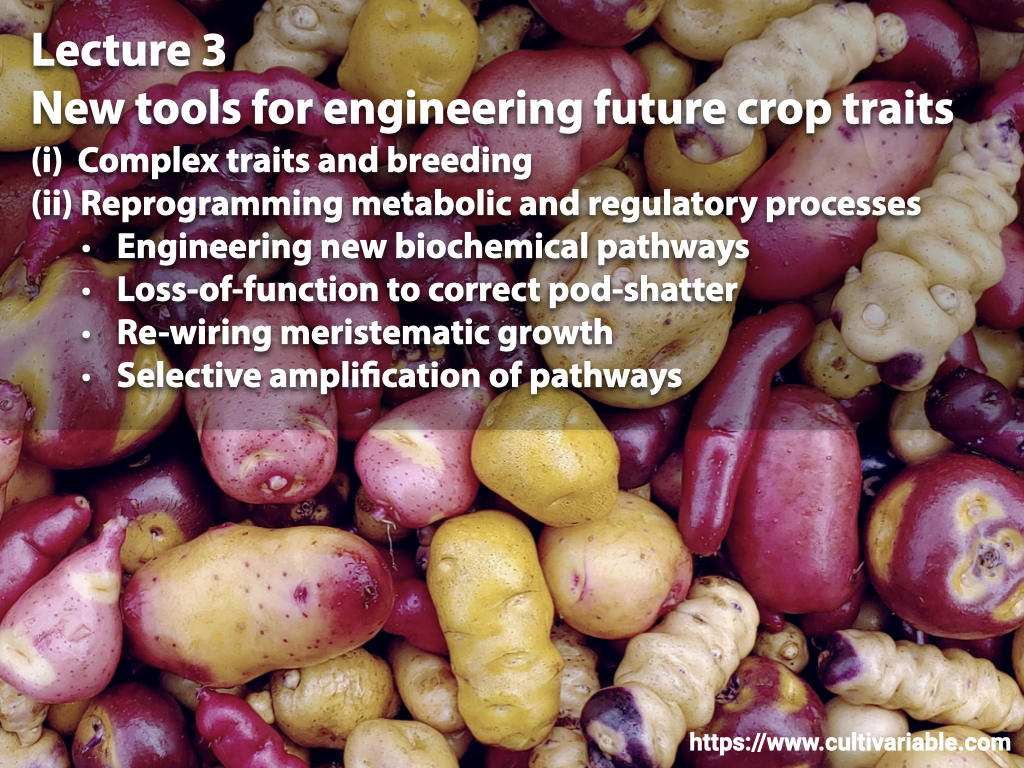
Lecture 3 outline: New tools for engineering future crop traits
Introduction to Modern Gene Editing Approaches
Modern gene editing and expression reprogramming techniques enable targeted modification of plant architecture, crop improvement, and the domestication of new species.
Examples of Ancient Crop Domestication
Watermelon: Originally used as water carriers, with selection for sweetness and colour.
Bananas: Domesticated in Papua New Guinea; evolved from diploid, seeded varieties to modern triploid, seedless forms.
Eggplant: Domesticated in Asia, leading to changes in size, colour, and alkaloid content.
Carrots: Domesticated in Central Asia; the orange variety became prevalent in the 15th-16th centuries in Europe.
Plasticity in Plant Morphology and Genomes
Plants, such as those in the Brassica family, exhibit significant morphological variation due to selective breeding. Examples include broccoli, cauliflower, cabbage, and kohlrabi, all derived from Brassica oleracea.
Convergent Trait Development: Different Brassica species independently developed similar traits due to common modifications in meristem identity and organ hyper-proliferation.
Crop Traits Selected During Domestication
Common traits include determinate growth, synchronous ripening, reduced bitterness, improved harvest index, larger seed size, seedlessness, and grain retention. Many of these traits are multigenic, affecting plant growth and morphology.
Understanding Genetic Control of Plant Development
Genetic studies, such as those on teosinte and maize, show that relatively few loci can account for major morphological differences. Understanding these interactions can aid future crop engineering efforts.
Exploration of Plant Diversity for Domestication
Out of 400,000 plant species on Earth, only about 20,000 have been used as food, with only 2000 having economic significance. Three crops—rice, wheat, and maize—dominate the world’s food supply, leaving a vast reservoir of untapped biological diversity.
Biochemical Pathways and Bioeconomy
Unique plant pathways produce valuable compounds. Research focuses on transferring these pathways to microbes or optimising them in plants for higher yields. Plants offer scalable, cost-effective options for bioproduction, supporting future bioeconomic models.
Transgenic organelles: Chloroplast Engineering for Crop Improvement
Chloroplasts, key to plant energy production, are targets for metabolic engineering. Examples include the transfer of the astaxanthin pathway into Nicotiana tabacum, producing high pigment levels.
Gene knockdown: Engineering Seed Retention in Oilseed Crops
Brassica napus (canola) was domesticated recently, and its seed shatter trait is a focus for genetic modification to reduce yield loss. Genetic engineering strategies, including CRISPR/Cas9, target genes like Shatterproof and Indehiscent.
Editing Regulatory Loops: Increasing Fruit Size in Tomato
New genome editing tools like CRISPR allow for precise modifications in regulatory genes. Examples include reprogramming shoot architecture and fruit development in tomato and Physalis species, optimising varieties for specific growth conditions.
Engineering Feedback in Plant Metabolic Pathways
By manipulating transcription factors, scientists have engineered cell wall composition for improved bioenergy feedstocks. Examples include altering the regulatory network in Arabidopsis to modify lignin biosynthesis and increase cellulose content.
Commercial Applications of Genetic Engineering
Biotechnology companies use targeted mis-regulation to amplify/reduce gene-regulated processes in crops. They aim to enhance agronomic traits like fruit size, shoot and root architecture biomass, chemical content and yield with minimal genetic manipulation. Gene editing techniques are providing the tools of choice for providing commercial varieties.
Future of Crop Improvement and Genetic Manipulation
The genetic plasticity of plants has been demonstrated through domestication. As gene editing technologies and our understanding of plant biology advance, opportunities for rational design of improved crop traits become more feasible, addressing global agricultural challenges.
Modern gene editing and expression reprogramming techniques enable targeted modification of plant architecture, crop improvement, and the domestication of new species.
Examples of Ancient Crop Domestication
Watermelon: Originally used as water carriers, with selection for sweetness and colour.
Bananas: Domesticated in Papua New Guinea; evolved from diploid, seeded varieties to modern triploid, seedless forms.
Eggplant: Domesticated in Asia, leading to changes in size, colour, and alkaloid content.
Carrots: Domesticated in Central Asia; the orange variety became prevalent in the 15th-16th centuries in Europe.
Plasticity in Plant Morphology and Genomes
Plants, such as those in the Brassica family, exhibit significant morphological variation due to selective breeding. Examples include broccoli, cauliflower, cabbage, and kohlrabi, all derived from Brassica oleracea.
Convergent Trait Development: Different Brassica species independently developed similar traits due to common modifications in meristem identity and organ hyper-proliferation.
Crop Traits Selected During Domestication
Common traits include determinate growth, synchronous ripening, reduced bitterness, improved harvest index, larger seed size, seedlessness, and grain retention. Many of these traits are multigenic, affecting plant growth and morphology.
Understanding Genetic Control of Plant Development
Genetic studies, such as those on teosinte and maize, show that relatively few loci can account for major morphological differences. Understanding these interactions can aid future crop engineering efforts.
Exploration of Plant Diversity for Domestication
Out of 400,000 plant species on Earth, only about 20,000 have been used as food, with only 2000 having economic significance. Three crops—rice, wheat, and maize—dominate the world’s food supply, leaving a vast reservoir of untapped biological diversity.
Biochemical Pathways and Bioeconomy
Unique plant pathways produce valuable compounds. Research focuses on transferring these pathways to microbes or optimising them in plants for higher yields. Plants offer scalable, cost-effective options for bioproduction, supporting future bioeconomic models.
Transgenic organelles: Chloroplast Engineering for Crop Improvement
Chloroplasts, key to plant energy production, are targets for metabolic engineering. Examples include the transfer of the astaxanthin pathway into Nicotiana tabacum, producing high pigment levels.
Gene knockdown: Engineering Seed Retention in Oilseed Crops
Brassica napus (canola) was domesticated recently, and its seed shatter trait is a focus for genetic modification to reduce yield loss. Genetic engineering strategies, including CRISPR/Cas9, target genes like Shatterproof and Indehiscent.
Editing Regulatory Loops: Increasing Fruit Size in Tomato
New genome editing tools like CRISPR allow for precise modifications in regulatory genes. Examples include reprogramming shoot architecture and fruit development in tomato and Physalis species, optimising varieties for specific growth conditions.
Engineering Feedback in Plant Metabolic Pathways
By manipulating transcription factors, scientists have engineered cell wall composition for improved bioenergy feedstocks. Examples include altering the regulatory network in Arabidopsis to modify lignin biosynthesis and increase cellulose content.
Commercial Applications of Genetic Engineering
Biotechnology companies use targeted mis-regulation to amplify/reduce gene-regulated processes in crops. They aim to enhance agronomic traits like fruit size, shoot and root architecture biomass, chemical content and yield with minimal genetic manipulation. Gene editing techniques are providing the tools of choice for providing commercial varieties.
Future of Crop Improvement and Genetic Manipulation
The genetic plasticity of plants has been demonstrated through domestication. As gene editing technologies and our understanding of plant biology advance, opportunities for rational design of improved crop traits become more feasible, addressing global agricultural challenges.
Extended reading:
De novo domestication: retrace the history of agriculture to design future crops. J Zhang, H Yu & J Li, Current Opinion in Biotechnology 81:102946, 2023.
Applications of CRISPR–Cas in agriculture and plant biotechnology. H Zhu, C Li and C Gao, Nature Reviews: Molecular Cell Biology 21:661-677, 2020.
Perspectives of CRISPR/Cas-mediated cis- engineering in horticulture: unlocking the neglected potential for crop improvement. Q Li, M Sapkota & E van der Knaap, Horticulture Research 7:36, 2020.
Molecular mechanisms involved in convergent crop domestication. Teresa Lenser and Gunter Theißen Trends in Plant Science, Vol. 18, No. 12, 2013.
Role of the FUL–SHP network in the evolution of fruit morphology and function. Cristina Ferrándiz & Chloé Fourquin, Journal of Experimental Botany, Vol. 65, No. 16, pp. 4505–4513, 2014.
Bayer trait development story: Strong seed pods. Bayer Research, 2014.
De novo domestication: retrace the history of agriculture to design future crops. J Zhang, H Yu & J Li, Current Opinion in Biotechnology 81:102946, 2023.
Applications of CRISPR–Cas in agriculture and plant biotechnology. H Zhu, C Li and C Gao, Nature Reviews: Molecular Cell Biology 21:661-677, 2020.
Perspectives of CRISPR/Cas-mediated cis- engineering in horticulture: unlocking the neglected potential for crop improvement. Q Li, M Sapkota & E van der Knaap, Horticulture Research 7:36, 2020.
Molecular mechanisms involved in convergent crop domestication. Teresa Lenser and Gunter Theißen Trends in Plant Science, Vol. 18, No. 12, 2013.
Role of the FUL–SHP network in the evolution of fruit morphology and function. Cristina Ferrándiz & Chloé Fourquin, Journal of Experimental Botany, Vol. 65, No. 16, pp. 4505–4513, 2014.
Bayer trait development story: Strong seed pods. Bayer Research, 2014.
Practical class exercise
Plant transformation and use of reporter genes and microscopy of plants.
In the practical session there are several objectives: (i) to describe gene fusions, (ii) the use of reporter genes in plants, and (iii) the use of microscopy techniques for reporter gene detection in the context of plant transformation.
Download quiz sheet…
and when you would like to check your answers….download the answer sheet.
In the practical session there are several objectives: (i) to describe gene fusions, (ii) the use of reporter genes in plants, and (iii) the use of microscopy techniques for reporter gene detection in the context of plant transformation.
Download quiz sheet…
and when you would like to check your answers….download the answer sheet.